
FEBRUARY 2026-02 Volume 1, Number 2
Words and photos by Mike Evans
Intro
It seems spring could already be hiding just around the corner, but we still have a pretty good potential for actual winter. We hope. So far, we have had no severe cold spells, and while we got good ground soaking in the Christmas and New Year’s storms. January was basically warm and dry in Southern California, and outright hot towards the end. Currently, the rest of the country is experiencing freezing temperatures.
Current events, history, review, and notes
Thanks again for your interest in our new nonprofit, CalNativeHort. On a personal note, I will share that the take-down of Tree of Life Nursery is almost complete, after having started over two years ago. I thank my business partner, Jeff Bohn, and our incredible staff for keeping to task on what has been a difficult and emotional adventure. The place and the business were 45 years in the making, and about 3 years in the disassembling.
The good and exciting news is that I will have more time for CalNativeHort. I am learning that I am better at building stuff than I am at taking it apart. But we all do what we have to do, right?
In the News
Both our membership and our mailing list are growing. We are actively pursuing a couple of very promising leads to secure a permanent home for CNHF, where we will build a teaching nursery, hold workshops and seminars, sell native plants, and create a valuable botanical and horticultural resource for Southern California. Stay tuned.
Native horticulture this month
Our thoughts for February in the natural garden usually go straight to flowers. Manzanitas are blooming. This year, many Ceanothus are early, in bud and bloom. Spring-flowering sub-shrubs like salvia and monkey flower are showing promise, and our native pollinators (especially hummingbirds) are making a strong debut.
February beckons us outdoors, into our gardens, and into the wild places after which our gardens are modeled. As far as garden activity is concerned (I try to avoid the term “garden chores”), you can do as much or as little as you feel like. It is still early in the season, so immediate action is ok, but so is procrastination. Now, doesn’t that sound nice?
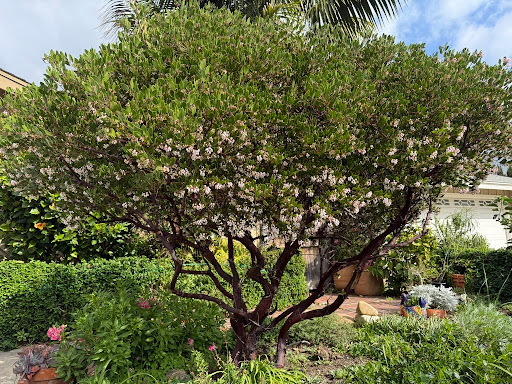
A lovely manzanita selection, Arctostaphylos densiflora ‘Howard McMinn’, begins flowering on its lower branches, and blooms progressively higher up the plant for over a month. This specimen is over 30 years old and stands about head-high, delighting everyone throughout the year, especially in winter.
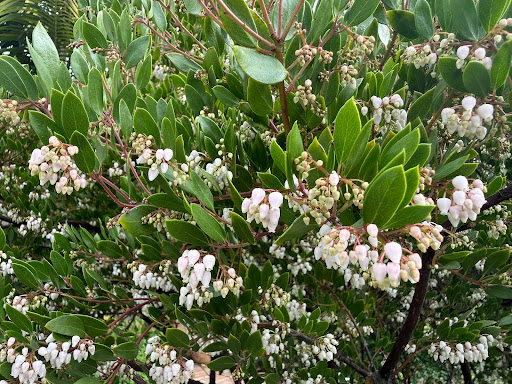
The first flowers to open on the lower branches
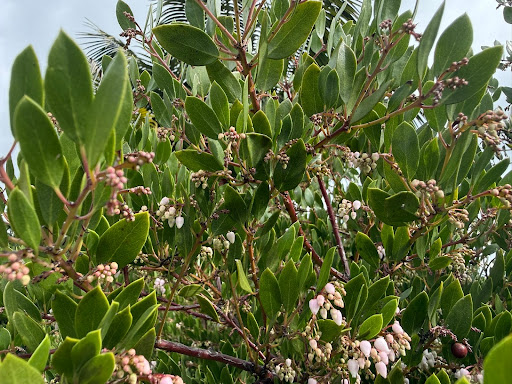
Higher up, in the plant’s upper branches, flower buds will be opening over the next few weeks, making this plant a hummingbird’s favorite for at least a month!
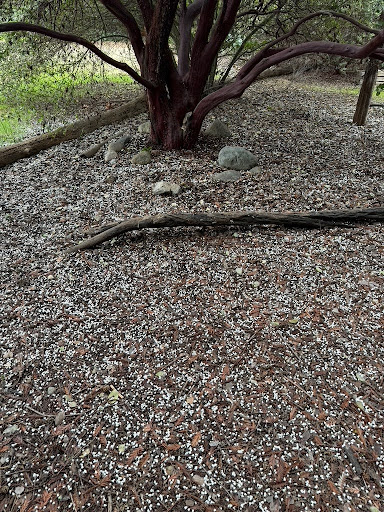
Meanwhile, back at the ranch, a taller manzanita selection, Arctostaphylos manzanita ‘Dr. Hurd’ is blooming and leaving a lovely dusting of “flower snow” at its base.
Watering
The soil is probably still quite moist in most areas. We saw almost no rain after New Year’s, so we needed to water our potted plants, plus any newly planted plants. We still have 3-5 months ahead where we can get significant rain. Here, in San Juan Calpistrano, we have received 10.30 inches for the season, so as far as “watering” is concerned this year, this month, we say, “so far, so good.”
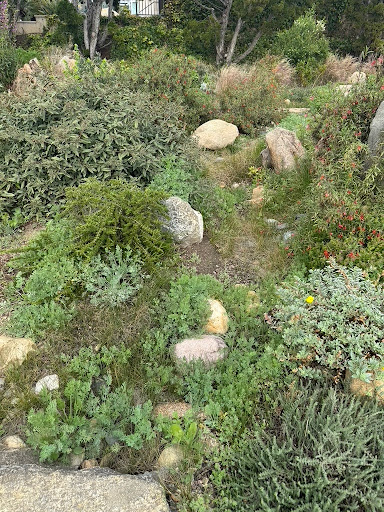
This diverse planting of natives is sustained almost entirely throughout the whole year by the deep soaks achieved from the functional swale during winter rains.
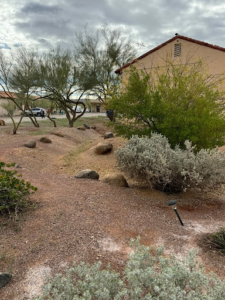
Here’s a functional swale ending in a big soak basin, located in a desert garden where summer monsoons often cause flash floods. Curley Conference Center, Ajo, Arizona.
Pruning, Weeding, Feeding, Mulching/Top Dress
Pruning: While no major work event is necessary this month, I believe one way we can stay connected to our gardens is to snip a few branches, shaping, thinning, heading back, and grooming, on a fairly regular basis. Try this: when you go out to enjoy your garden or just passing through, take your (clean) shears with you. Invariably, you will see a broken stem, branch tip, or some errant, weird growth pattern that can only be improved by light pruning. This is horticulture.
Weeding: Yes, especially since we got such good rains early in the season.
Feeding: No. It can wait until the soil warms up.
Mulching/Top Dress: Probably no, unless you are doing it because you just finished a massive weed eradication and you have sown new wildflower seed and/or you want the “fresh” look of new mulch.
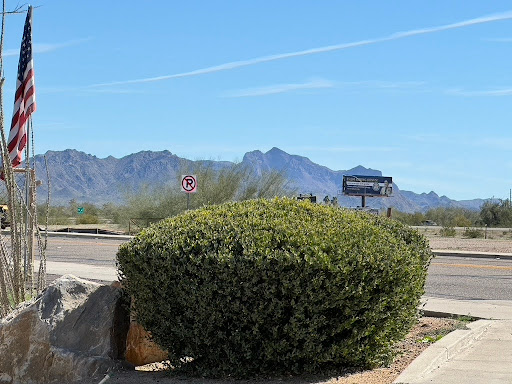
What did this poor jojoba do to deserve such treatment? Deserves more respect. Don’t prune like this unless your narrative is entitled “Topiary Garden.” Oh, by the way, if it were a topiary garden I guess this proves that jojoba would be a good choice. This plant seems healthy, but I’m not sure it’s happy.
Troubleshooting – Varmints, Pests and Diseases
With good rains and abundant growth often come gophers. These little guys are always most discouraging. My personal favorite for trapping is the Macabee Gopher Trap. Write to me for advice on their precise use, or Google it. You can get good at this. Of course, you can also pray for the success of the local hawks and owls
p.s. Please don’t tempt me to make a joke about skinning the gophers and sewing their pelts together to fashion yourself a little purse. Last time I did that, about 15 years ago, I got some pretty nasty emails.
Regarding insects and mites, it is still a little cold for most injurious insect pests, but be on the lookout for Argentine ants, which, when present in abundance, can nurture their personalized herds of aphid, mealybug, scale, etc. on your plants. More on this as we get into spring and summer.
Diseases on native plants are mostly dormant in winter. To prepare for warmer temperatures, be sure to provide good air circulation in and around the branches of your plants. See “Pruning” above.
Adding plants and seed
Our fall/winter/spring season is the ideal time to plant natives. If you haven’t already seen it, look back at last month’s CONNECT (Vol. 1 No. 1, January 2026) for an extensive treatment of soil amendments to consider for planting new plants.
Regarding seeds, February, especially this year, since we haven’t really seen winter yet, is not too late to sow wildflower seeds.
My Patio Re-wild (small space)
Looking for a fun activity on a rainy day? Would you like to add a “natural” stone planter to your collection of potted plants? Wanna get your hands dirty (well, at least put your rubber gloves to use)? Need to keep those kids out of trouble for a couple of hours? Well… here’s an activity for you!
Look up (“Google”, don’t you love that word when used as a verb?) “How to Make a Hypertufa Pot”. Dozens of sites will come up. Scroll around, click, and do all your “research,” then give it a shot. The thick walled pot you make will be ideal for natives since these containers drain well and breathe. They also offer a rustic look and blend well with all the other features of your natural garden. Let me know how it goes. Send pictures.
Phytophilia
Our love for plants and their reciprocal response. Or is it plants’ love for us and our reciprocal response?
This month, I believe I can hear the plants’ message for me carried to me by way of birdsong. And my message back to them? Via my thoughts, I hope. If ever I doubt the plants might “know” my thoughts towards them, I simply speak to them outloud. I guess that’s why I love learning plant names. At least I can converse with them and address them as a proper friend.
Re-wild Principles
Clean up where necessary. An easy way to make the accumulated organic matter covering the ground in your natural garden look amazing is to keep the adjacent paths and walkways clean. The distinct difference will remind everyone that yours is a garden, and that the so-called “leaf litter” is intentional, because you are keeping all the human areas tidy.
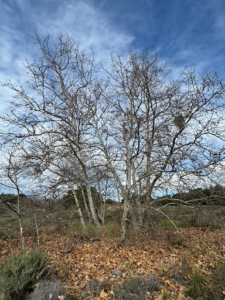
Sometimes, trees leave a mess. But so do kids, and both are worth having around.
Important Review
What happened to winter?
Mike’s mind, TOLN take down, CBHF build up
Site for CalNativeHort nursery and botanic garden, good potential, stay tuned
Early spring flowers and freedom to work and enjoy the garden
January is dry after the holidays, but the ground is still moist
Prune yes, Weed yes, Feed no, Mulch no
Gophers are not our friends
Great time for plants, not too late for seeds (this year)
Hyper-tufa pots, fun and easy
Learn plant names, talk politely to plants
Rake and sweep the paths
Engage
For the most part, a garden is an interpretation of nature, appropriate to the particular narrative of its time and place. Gardens tell stories. By definition, what we call a “natural garden” speaks in whispers, soft tones, and sometimes even through silence. But we can hear it because our ears are tuned.
I like to find a few minutes every day to walk through even the most familiar sections of a garden in order to hear its message for me at that moment. A time and a place for everything. We can plan a garden party with people, food, drink, and celebration, or we can stroll through or just sit quietly in our gardens to find silence, solitude, and inner peace. It’s nice to have such a versatile, serviceable space so close at hand.
From February CalNativeHort CONNECT,
Mike Evans
Questions? Help is just one call or one email away. connect@calnativehort.org