
A garden puts living art on display. The parts that are alive are the plants, and choosing the right ones, combining them in a creative design, and planning for long-term success, make these choices, the combinations, and your plans an exciting (at times daunting) challenge.
What to plant, that is the question.
Here are six test questions for every planting project whatever your title; natural garden, native plant landscape, or re-wild:
- Do the plant choices help define the overall story you are trying to tell?
- Do the plant combinations employ the basic art elements and art principles in their visual presentation?
- Art elements
- Color, form, line, shape, space, and texture
- Art principles
- Balance, emphasis, movement, proportion, rhythm (repetition), unity, and variety
- Art elements
- Does the planting plan interpret any aspect(s) or example(s) of nature, consistent with the defining narrative?
- Do the plant varieties share common horticultural factors; tolerances and requirements?
- Soil type, water needs, compatible growth rates, care needs
- Environmental
- Exposure; sun/shade, wind, slope,
- Temperatures
- Seasonal extremes
- Will the mature garden thrive and adapt as a living, cohesive, functional, sustainable, and regenerative organism?
- Are the plants readily available in the nurseries?
After the non-living essential components of your garden are in place, i.e.; functional swales, basins, boulders, rocks, fountains, springs, paths, landings, perches, patios, benches, structures, furniture, garden art, etc., you bring in the plants.
To properly answer the above questions, for each question you will employ a different discipline to get the answer:
#1 A storyteller
#2 An artist
#3 A naturalist or ecologist
#4 A horticulturist
#5 A caregiver
#6 A grower or a buyer
Choosing the right plant is a multidisciplinary endeavor.
If you allow these six disciplines to be separately defined, and you strive to become proficient in each one, (or look outside for help from experts in their special field) you will be able to choose the right plants for every garden you make.
The key is employing every discipline in turn, and combining them into one job title:
“Creator and Keeper of Natural Gardens.”
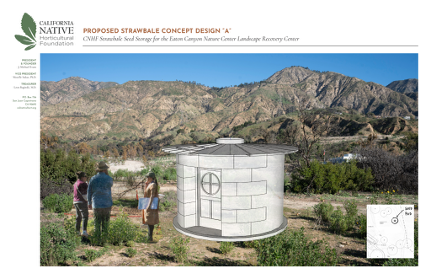
Strawbale Shed
Cal Native Hort is honored to be a part of the Landscape Recovery Center at Eaton Canyon. We are building a 120’ square foot Strawbale demonstration shed with Levi Brewster, garden educator and building contractor, this summer.
It will be made of densely packed straw bale building, sealed within a natural plaster, creating walls with exceptional thermal mass and low flammability. Unlike the wood-frame construction that characterizes most of what burns in wildland-urban interface fires, strawbale walls offer fire resistance ratings of two hours or more. The plaster skin is non-combustible; the compressed straw within is oxygen-starved and slow to ignite. A strawbale building is not fireproof, but it is fire-resilient in a way that conventional wood construction rarely achieves.