
JANUARY 2026-01 Volume 1, Number 1
Words and photos by Mike Evans
Intro
Welcome to Vol. 1, No 1, as we meet at the trailhead for CalNativeHort CONNECT, our new monthly newsletter for our new community. We’re in this together. I would love to hear your suggestions and feedback. Let’s go!
Current events, history, review, and notes
California Native Horticulture Foundation launched in the fall of 2025, on the heels of Tree of Life Nursery closing down, after 45 years of growing natives. We can now continue to build our native plant community with a broader focus and statewide potential, one member, one event, one newsletter at a time. Welcome to the community. You are an integral part, so we are looking forward to your involvement.
In the News
Thank you to our nearly 200 Inaugural Members who joined in 2025 when membership opportunities first became available on October 1. Also, a big thank you to those who continue to join since the new year..
Native horticulture this month
In California, we have no guarantees for rain, and the patterns are too varied from year to year to allow us to expect anything but an annual surprise. Each year, around October, we wonder. By December/January, we think we have a pretty good idea. But only as the last rains fall in April/May, and the rain gauge reveals its cumulative total, do we get the season’s full story. In our 2025-26 rainy season (officially July 1 through June 30), December was mostly dry… until Christmas time, when we started to get soaked. More rain came early January, and we’re standing at around 10” so far (San Juan Capistrano), when we had less than 6” right up to Christmas Eve. So far so good!
Watering
Needless to say, we do not need to even think about watering our naive gardens for a few months. This season’s rains, especially the soaking nature of their occurrence, will provide deep moisture for our plants clear through to spring.
Pruning, Weeding, Feeding, Mulching / Top Dress
The biggest task this month will be weeding. It is safe to prune this month, but most of the shaping and corrective pruning should have been done in Oct/Nov. It is too cold for organic fertilizer to be of much effect. Top dress can be applied if necessary, but the best leaf mulch is the natural leaf accumulation on the ground, under each plant… the build up of “leaf litter.” But go after those weeds. If you sowed seed last fall, your challenge will be to pull the weeds and not the flowers. Let us know your technique on that!
A brief word on pruning:
The effects of the copious rains are already starting to show up, vigorous growth and elongated branches. When the sun comes out and as the days get longer, the soil and weather get warmer, plants are going to be growing like crazy this year. Do a little pruning along the way, don’t wait for a big “pruning day” in May (though you may do that as well), but keep plants tidy by trimming branch tips as you see fit.
Reminder: Always practice good garden hygiene when pruning by periodically sanitizing your tools. When pruning diseased branches, sanitize between every cut. Dip your shears for eight seconds in a solution of nine-parts water, one-part bleach (10% bleach solution), and also use this to wipe down your saw blade. Rubbing alcohol or Lysol spray are both equally effective. Thoroughly rinse your tools before storing them away, as the bleach is caustic.
One more reminder: Don’t cut off spring bloom by severing branch tips bearing latent buds. Carefully inspect before pruning, i.e., Ceanothus, which bloom in March/April, may have hidden flower buds now.
Troubleshooting – Varmints, Pests, and Diseases
Everything is pretty soaked right now, even the gophers are learning how to swim. Not many plant diseases attack natives in winter. As we get into warmer nights, you might see downy mildew killing whole branches. This is a perplexing disease. It seems to like grey fuzzy leaves the best, like certain buckwheats and sages. But it can get any plant, especially soft-branched subshrubs. If you see whole branches going brown, quite suddenly, suspect downy mildew. The organic remedy: prune out (and discard in the trash) the affected branches, thus improving air circulation in the center of the plant.
Adding plants and seed
Our fall/winter/spring season is the ideal time to plant natives. This year, this month, the soil is very saturated, which might make planting a bit of a challenge. If you try planting during an actual rain event, you will definitely be pleased with the results. January is not too late to sow native wildflower seed.
A brief word about soil amendment in planting:
The term “Amendment” refers to the organic material you would add to the soil to enrich it.
The term “Pre-plant fertilizer” refers to the actual plant food you include in the planting process.
The term “backfill” refers to the soil that will be returned to the planting hole, around the nursery root ball.
The term “amended backfill” refers to the backfill, which is a blend of native soil, compost, and fertilizer.
To amend or not to amend. That is the question.
You might sometimes hear that “natives are tough, just kick some dirt back in the hole and let ‘em fend for themselves.” While it’s true that natives are strong, sturdy plants in the landscape, we would do well to treat them kindly during their transition from the nursery container to the natural garden. Therefore, regardless of the quality of your soil, both you and your plant will benefit by including organic amendment and pre-plant fertilizer in the backfill. The amended backfill only serves to offer a smooth transition for the plant, so it can send new roots out from the nursery root ball, through the backfill, into the native, unamended soil. You must always choose plants that will ultimately grow in your native, unamended soil.
Amend the backfill by thoroughly mixing 1/3 compost to 2/3 native soil, outside the hole, and include a generous handful of all-purpose organic fertilizer and a half handful of bone meal, all blended. (The handful measurements are for 1-gallon plants; you should increase for larger planting holes.)
Be sure and keep the hose running at a trickle as you backfill the hole, to prevent air pockets or dry spots, and to assure the new plant is thoroughly watered when you are finished. Or plant in the rain.
For most native plantings, it is not necessary to amend all the soil, which is a common practice when landscapers install turf. Native plants do not require such extravagance. But by amending each planting hole, you are giving each plant a healthy start; good for them, and good for you because of the extra time you are taking to nurture them. It’s like feeding your dog, a reciprocal action where both parties benefit.
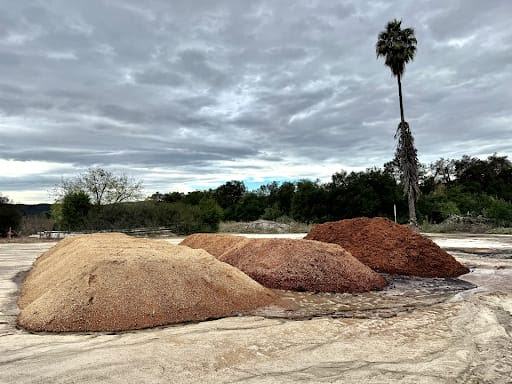
Fresh wood shavings, like white fir or redwood (pictured above) can be used. Since they are not composted, you need to nitrolize the raw material by thoroughly blending 1 lb. Urea (46-0-0) per cubic yard, turning and watering the pile, then letting it mellow for a few weeks before incorporating it into your planting holes. Adding nitrogen to fresh raw shavings will speed up the composting process and ensure that when the material is incorporated in the soil, it will not “rob nitrogen” from the newly planted plant.
Actual compost, i.e.;worm castings, mushroom compost, forest duff or other aged organics such as well composted green waste do not need to be nitrolized before use. Usually you can tell the difference by the color and smell. Compost is dark, and smells earthy. Shavings are light colored, and smell like lumber. Aged compost is preferable as a pre-plant amendment. If any organic material stinks, don’t use it.
My Patio Re-wild (small space)
One advantage of containers or raised planters is that you can blend a custom soil to suit plants that may require soil conditions perhaps vastly different than your native soils. For instance, desert plants that require good aeration will thrive in pots of planters, but if you have heavy clay soil and you put them in the ground, they will not be happy. Also, acid loving plants that will give you a certain central/north coast theme, or a theme reminiscent of the mountains, where thick layers of forest duff provide a high percentage of organic matter, can be grown in pots or raised planters because you have provided for the roots’ specific needs. Try using containers or raised beds to increase the diversity of plant types in every corner of your garden space.
Phytophilia
Our love for plants and their reciprocal response. If nothing else, plants everywhere are boasting the results of their thorough bathing they got with all this rain. Clean at last! Dust and grime washed away, they can finally get busy on the efficient business of photosynthesis, especially as we see more sunny days with longer hours of daylight.
Re-wild Principles
This is almost too simple. Whether you are making a brand new garden, or connecting to your old friend the established garden, there’s always room for rocks. Rocks? Boulders, rocks, stones, pebbles, aggregate, sand… any mineral element, but for now… rocks. More rocks Inspiration for our re-wild gardens comes from nature. California is blessed with great geologic beauty, so bring rocks of all sizes into your garden and see how beautifully they fit in the theme, unless you have a very specialized theme like sand dune or mountain meadow. Artfully placing rocks in the natural garden is a time honored tradition in many cultures. Suffice it to say, nature is the model. Next month… Rocks as “jewels” in the garden’s wardrobe.
Important Review
New newsletter
New nonprofit
New members
Plenty rain
No watering needed
New weeds, elongated growth
Plant with amendment, here’s how
Special soil in pots and raised planters
A bath feels good
Rocks and plants make good partners
Engage
January 2025, and my recent efforts to “engage” with nature on New Year’s Eve resulted in a sinus infection. Yes, my dog and I hiked in the cold rain. Yes, I already had a cold, and yes, It got a lot worse. Someday I may learn to act my age. Maybe.
Here’s one from the archives until I feel up to writing a fresh piece next month:
The Salmon Creek Gate
Once the wood becomes covered
in green moss and brightly colored lichen,
a gate, any gate has likely
been shored up, modified, and repaired,
over and over and over,
again in attempts to keep it functional.
Then eventually forgotten.
The time comes
when it will no longer swing on its hinges.
It gets propped up
crooked,
the slats embraced and entangled
by coyote bush
and morning glory.
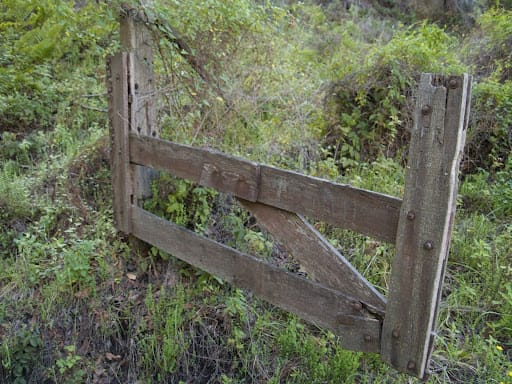
Marking the trail head,
the Salmon Creek gate would occasionally
be closed
during fire seasons past,
back when you could move it,
back when a ranger lived here.
But the gate got old
and the ranger had to leave.
It stayed open
and the house got boarded up.
Things change.
I like to imagine the day they built the gate.
Guys in uniform
with hand tools, pride, and purpose,
hauling the boards, the bolts,
the brace and bit, wrenches and saws, hammers and all,
of course the hinges and latch,
up the hill from their truck.
Probably several trips.
A post hole digger
mattock, bar, and shovel.
You can see skill in a hole,
fresh dirt piled on the side,
with a few rocks.
I wonder if they used a level, a plumb bob,
or the horizon to set the posts straight.
Good honest work
building gates in the mountains,
the boom of crashing surf
way down below,
a redtail screeching for his mate
way up yonder.
Some things never change.
We should all show respect
for a hand made gate,
in both its practical construction
and its ascribed authority.
Consider it well – right here on public land
marking the start and finish of our trail.
It has weathered gracefully
through innumerable seasons,
a thousand nights and days.
Most winters, it rains a lot in the Big Sur.
You can count on it.
Recently though, I saw the gate
all broke up.
Someone had had their way with it
using rocks or sticks or something.
Did they find pleasure
in destroying it
innocently open,
too old really, to be of much use,
a frail remnant
from a gentler time?
The wood was quite brittle.
Maybe they busted it into kindling
for their fire (illegal)
over there under the bays.
Perhaps they thought they were protesting
the meaning of gates in general,
but more likely they were just
showing off for their girlfriends.
Regardless, the wood gate is now gone,
replaced by a pre-fab metal affair,
galvanized, if I’m not mistaken.
Installed, I suppose
unceremoniously on a work-order
as a solution to a problem.
-Mike Evans – November, 2011
From January CalNativeHort CONNECT,
Mike Evans
Questions? Help is just one call or one email away. connect@calnativehort.org